We have some unfortunate news for all the readers and friends of the blog
Ridwan passed away on Wednesday 2 July 2014. He succumbed to a heart attack.
The blog had become an important part of his life over the last few years, and we want to thank the readers and friends for their contributions and support over the years.
Sunday, July 06, 2014


Friday, June 27, 2014
Seeking Justice—Or at Least the Truth—for “Comfort Women”
Christine Ahn
June 24, 2014.
A growing global movement is ensuring that if the Japanese government won't hold itself to account for its crimes against women, then history will.

It is shameful nationalist politics and it won't make the past disappear.
I have followed this story for many years here on the blog and elsewhere in my academic work. And for this reason I look forward to the forthcoming film "Within Every Women: Secrets, Shame and Strength. A story of three grandmothers enduring and unending war". See a sample reel here.
I also find the struggle story of the golden bronze statue - the Pyeonghwa-bi (the Peace Monument) - absolutely remarkable in the manner that it presses political consciousness. The article above describes it so:
Onward!
June 24, 2014.
A growing global movement is ensuring that if the Japanese government won't hold itself to account for its crimes against women, then history will.
Former comfort women and their supporters dedicate a memorial to
victims
of the Japanese military’s sex trafficking of women
and girls during
the Second World War.
(Photo: Melissa Wall / Flickr)
On June 9, outside of Seoul, 91-year old Bae Chun-hui took her last gasp of air at the House of Sharing, a communal home established for former “comfort women” in South Korea to live out their remaining years in peace.Read the rest here.
Bae was kidnapped at the age of 19 and taken to Manchuria, where she was forced into sexual slavery until the end of the Second World War.
Not only did Bae die without achieving justice. In her final days, she also witnessed Japan’s shameful efforts to wring its hands of war crimes its military committed against an estimated 200,000 women and girls from throughout Asia during the Pacific wars of the 1930s and ’40s.
Bae was among the Korean women who spoke out after the former comfort woman Kim Hak-sun broke her silence in 1991 and publicly recounted her abduction and sexual torture by Japanese soldiers. In her testimony, Kim painfully recalled: “A commissioned officer took me to the next room which was partitioned off by a cloth. Even though I did not want to go he dragged me into the room. I resisted but he tore off all of my clothes and in the end he took my virginity. That night, the officer raped me twice.”
Kim lifted the floodgates for other Korean women to come forward. Burmese, Chinese, , Japanese, Filipina, Taiwanese, Vietnamese, and Pacific Islander women also verified that their experiences were not isolated, but were the outcome of a systematic, well-organized government program to establish “comfort stations” for Japanese soldiers throughout Asia and the Pacific.
The Japanese government has vigorously resisted calls to repent for its actions. But a growing global movement is ensuring that if Japan won’t hold itself to account for its grievous crimes against these women, then history will.
*****
Comment: Japan's Prime Minister Shinzo Abe is key among those who would rather round-up a revisionist history than confront what Japan did to the so-called "comfort women".It is shameful nationalist politics and it won't make the past disappear.
I have followed this story for many years here on the blog and elsewhere in my academic work. And for this reason I look forward to the forthcoming film "Within Every Women: Secrets, Shame and Strength. A story of three grandmothers enduring and unending war". See a sample reel here.
I also find the struggle story of the golden bronze statue - the Pyeonghwa-bi (the Peace Monument) - absolutely remarkable in the manner that it presses political consciousness. The article above describes it so:
Since 1992, at noon on every Wednesday, irrespective of rain or snow, Korean comfort women and their supporters have stood across the street from the Japanese embassy in Seoul, calling upon the Japanese government for justice and reparations.In the coming year or so I would like to travel to Seoul and watch this struggle at noon on a Wednesday.
On December 14, 2011, to commemorate the 1,000th protest, they installed Pyeonghwa-bi, or the Peace Monument—a golden bronze statue of a barefoot teenaged girl sitting in a chair with her hands gently resting on her lap. On her left shoulder rests a small bird symbolizing the innocence of the young girls and women forced into sexual slavery.
Onward!
Wednesday, June 25, 2014
When Islam came to Australia
Janak Rogers
June 24, 2014.


I am not surprised though.
About 15 years ago I met a Native Indian brother in the US who told me about Muslims who travelled to what is the US now before white colonization - or, before Columbus 'discovered' the Americas.
He spoke about the influence of Islam on Indians somewhere - and about intermarriage - but I never followed up. Well once I looked for literature on what he told me but I did not find any online.
If you know more please do tell.
Onward!
June 24, 2014.
Few Australians are aware that the country's Aboriginal and Torres Strait Islander peoples had regular contact with foreign Muslims long before the arrival of Christian colonisers. And Islam continues to exercise an appeal for some Aboriginal peoples today, writes Janak Rogers.
The white lines are faint but unmistakable. Small sailing boats, picked out in white and yellow pigment on the red rocks of the Wellington Range in Arnhem Land, northern Australia, tell a different story from the one most Australians accept as the history of their nation.
They are traditional Indonesian boats known as praus and they brought Muslim fishermen from the flourishing trading city of Makassar in search of trepang, or sea cucumbers.
Exactly when the Makassans first arrived is uncertain.
Some historians say it was in the 1750s, but radiocarbon dating of beeswax figures superimposed on the cave paintings suggests that it was much earlier - one of the figures appears to have been made before 1664, perhaps as early as the 1500s.
A cave painting of an Indonesian prau, found in Arnhem Land
They apparently made annual trips to gather the sea cucumbers, which fetched a high price because of their important role in Chinese medicine and cuisine.Read the rest here.
The Makasssans represent Australia's first attempt at international relations, according to anthropologist John Bradley from Melbourne's Monash University - and it was a success. "They traded together. It was fair - there was no racial judgement, no race policy," he says.
Quite a contrast to the British. Britain designated the country terra nullius - land belonging to no-one - and therefore colonised the country without a treaty or any recognition of the rights of indigenous people to their land.
Some Makassan cucumber traders stayed, married Aboriginal women and left a lasting religious and cultural legacy in Australia. Alongside the cave paintings and other Aboriginal art, Islamic beliefs influenced Aboriginal mythology.
"If you go to north-east Arnhem Land there is [a trace of Islam] in song, it is there in painting, it is there in dance, it is there in funeral rituals," says Bradley. "It is patently obvious that there are borrowed items. With linguistic analysis as well, you're hearing hymns to Allah, or at least certain prayers to Allah."
*****
Comment: "You live and learn" like my landlady Nancy in Baltimore used to tell me in the late 90s. I did not know anything about Muslims in what is now Australia before white colonization.I am not surprised though.
About 15 years ago I met a Native Indian brother in the US who told me about Muslims who travelled to what is the US now before white colonization - or, before Columbus 'discovered' the Americas.
He spoke about the influence of Islam on Indians somewhere - and about intermarriage - but I never followed up. Well once I looked for literature on what he told me but I did not find any online.
If you know more please do tell.
Onward!
Monday, June 23, 2014
Student Gets Trapped In Giant Stone Vagina
The Huffington Post (UK)
June 22, 2014.
An American exchange student had to be rescued after getting trapped in giant stone vagina.
Five emergency service vehicles and 22 fireman had to help the unfortunate lad after he got stuck in the marble carving in Tübingen, Germany on Friday afternoon.
The student is reported to have climbed in after a dare.

Erick Guzman who witnessed the incident posted on Imgur: "I was there!!! He just wanted to take a funny picture.
"The fire department was not really amused, and he was really embarrassed."
The sculpture Pi-Chacán, by Peruvian artist Fernando de la Jara, has been in its current location at the town's university for around 13 years.
Read the original article here.
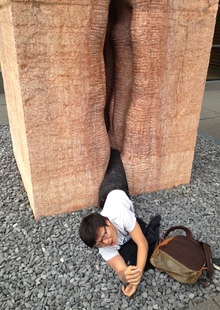
There are so many descriptors to throw at this student; it's not like he was born yesterday ;0)
Onward!
June 22, 2014.
An American exchange student had to be rescued after getting trapped in giant stone vagina.
Five emergency service vehicles and 22 fireman had to help the unfortunate lad after he got stuck in the marble carving in Tübingen, Germany on Friday afternoon.
The student is reported to have climbed in after a dare.
"The fire department was not really amused, and he was really embarrassed."
The sculpture Pi-Chacán, by Peruvian artist Fernando de la Jara, has been in its current location at the town's university for around 13 years.
Read the original article here.
*****
Comment: See also more coverage in today's Guardian (UK) - particularly the comments section.
The student waits to be rescued.
(Photograph: Erick Guzman/Imgur)
There are so many descriptors to throw at this student; it's not like he was born yesterday ;0)
Onward!
Sunday, June 22, 2014

"Look at us baby, up all night"
"Aren't we the same two people who lived
through years in the dark?" (Eagles)
through years in the dark?" (Eagles)
Saturday, June 21, 2014
Major US church votes to sanction Israel
June 21, 2014.
Presbyterians say move to pull investments modelled on campaign against apartheid in South Africa.
A leading Christian church in the United States has endorsed a policy of divestment to protest Israel's policies towards Palestinians, deciding to sell church stock in three companies whose products Israel uses in the occupied territories.
The Presbyterian Church (USA) general assembly voted on Friday by a razor-thin margin, 310-303, to sell stocks in Caterpillar, Hewlett-Packard and Motorola Solutions.
Carol Hylkema of the Israel/Palestine Mission Network, a Presbyterian group that advocates for Palestinians and spearheaded the drive for divestment, said their action was modelled on the divestment movement to end apartheid in South Africa.
"It was because of divestment that we were able to break the apartheid in South Africa," Johnnie Monroe, a pro-divestment Presbyterian, told Al Jazeera. "The church has to make a moral stance for moral justice."
A church spokeswoman estimated the value of the Presbyterian holdings in the three companies at US$21m.
Two years ago, the general assembly rejected a similar divestment proposal by two votes.
Heath Rada, moderator for the church meeting held in the US city of Detroit, said immediately after the vote that "in no way is this a reflection of our lack of love for our Jewish brothers and sisters."
The decision is expected to reverberate well beyond the church.
"It was a vote heard halfway around the world in Israel," Al Jazeera's John Hendren, reporting from Detroit, said.
In a separate vote, the assembly also voted to re-examine its historic support for a two-state solution.Read the rest here.
*****
Comment: Excellent decision despite the thin margin.
BOYCOTT ISRAEL !!!
Onward!
Thursday, June 19, 2014
Julius Malema on White Friends
"If you have a white friend as a black person and he or she
doesn't know your language or is not taking the initiative to
learn your language that person is no friend at all."

Julius Malema at the State of the
Nation Address in Cape Town.
(Nardus Engelbrecht, Sapa)
*****
Comment: More dumbassedness from the clown prince of post-apartheid politics.*****
Onward!
How Black Panthers turned to North Korea in fight against US imperialism
The Guardian (UK)
Tania Branigan
June 19, 2014.Unpublished memoir reveals how a couple at heart of black freedom movement visited Pyongyang on ideological pilgrimage
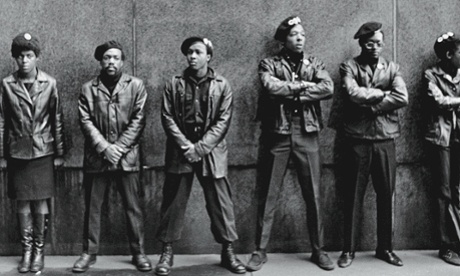
Black Panther Party members outside the New York City courthouse in April 1969.
(Photograph: David Fenton/Getty Images)
“Broken wine bottles and hypodermic needles are very effective. Pork chop and chicken bones can even be utilised as weapons,” the Black Panther newspaper instructed its readers in 1970. If the tone was familiar to them, the source of inspiration might have seemed less so: “This is ‘Juche’, relying on what you have, to sustain your resistance,” it explained.
The article was testament to an unexpected alliance. On one side was the California-based revolutionary socialist movement, declared by FBI director J Edgar Hoover “the greatest threat to the internal security of the country”.
On the other was “hermit kingdom” North Korea, with its ideological tenet of ‘juche’ or self-reliance; a country which then seemed something of a “Stalinist Switzerland”, recalls former Black Panther Kathleen Cleaver, now a law professor at Yale.
The ties between the two are more than a historical curiosity, says Benjamin Young, a contributor to NK News whose Masters research at the State University of New York: the college at Brockport, uncovered surprising details of the relationship.
It is a reminder that North Korea was not always “an economic basket case”, as declared by the Obama administration. At the time it appeared to be an east Asian success story, outperforming the South. The alliance also demonstrates the North’s long term interest in cultivating high profile international visitors and the Panthers’ search for support around the world.
“North Korea at this point was really on a global publicity campaign, even putting adverts in the New York Times and Washington Post promoting juche and peaceful reunification,” says Young.
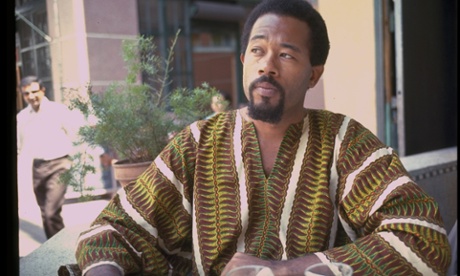
Black Panther Party leader Eldridge Cleaver, in exile.
(Photograph: Lee Lockwood/Time & Life Pictures/Getty Image)
Read the rest here.In Eldridge Cleaver, then a leading figure in the party and married to Kathleen Cleaver, they found an eager ally.
*****
Comment: I remember meeting Eldridge Cleaver just two weeks before he died in 1998.
The meeting took place at a university in Portland, Oregon, where I was a professor of Black Studies and faculty adviser to the student group who brought Cleaver to campus.
Cleaver did not spend too much time talking to me and I was less interested in talking to him. At that point the man had traversed the political spectrum from a being radical black Marxist to an ultra conservative Republican who believed that the US would be saved by a lesbian Jewish president.
While he was on campus he gave a lengthy talk on the relationship between ecology and the coming presidential savior.
When we heard about his death it was said that he died somewhere in California.
Politics not only makes for strange bedfellows it also makes for strange political journeys.
Onward!
Ps: See also "North Korea and the American Left" by Benjamin Young (Wilson Center) for links to the documents uncovering Eldridge Cleaver's relationship with North Korea.
Ps: See also "North Korea and the American Left" by Benjamin Young (Wilson Center) for links to the documents uncovering Eldridge Cleaver's relationship with North Korea.
Saturday, June 14, 2014
Happy Yemen
*****
Comment: By now you know that Pharrel Williams' Happy anthem is making its rounds across the globe.
My favorite is the version from Yemen but hey even South Africa is Happy, Palestine too, oh and Columbia.
And if you been paying attention these Happy Iranians pissed off the zealots.
Happy Muslims in Britain ... and the US. More American Muslims get Happy.
Huh?
What will the Imam say. ;0)
Happy Muslims in Britain ... and the US. More American Muslims get Happy.
Huh?
What will the Imam say. ;0)
Here's the original Happy.
I'm not Happy just in case you wondering ... well cause I can't sleep dammit (Saturday 4:29am).
Onward!
Thursday, June 12, 2014

Tuesday, June 10, 2014
The Korean grandmothers who sell sex
Lucy Williamson
June 9, 2014.

June 9, 2014.
Koreans could once be sure that their children would look after them in their old age, but no longer - many of those who worked hard to transform the country's economy find the next generation has other spending priorities. As a result, some elderly women are turning to prostitution.Read the rest here.
Kim Eun-ja sits on the steps at Seoul's Jongno-3 subway station, scanning the scene in front of her. The 71-year-old's bright lipstick and shiny red coat stand out against her papery skin.
Beside her is a large bag, from which comes the clink of glass bottles as she shifts on the cold concrete.
Mrs Kim is one of South Korea's "Bacchus Ladies" - older women who make a living by selling tiny bottles of the popular Bacchus energy drink to male customers.
But often that's not all they're selling. At an age when Korean grandmothers are supposed to be venerated as matriarchs, some are selling sex.
"You see those Bacchus Ladies standing over there?" she asks me. "Those ladies sell more than Bacchus. They sometimes go out with the grandpas and earn money from them. But I don't make a living like that.
"Men do proposition me when I'm standing in the alleyway," she adds. "But I always say, 'No.'"
Mrs Kim says she makes about 5,000 Won ($5, or £3) a day selling the drinks. "Drink up fast," she says. "The police are always watching me. They don't differentiate."
The centre of this underground sex trade is a nearby park in the heart of Seoul. Jongmyo Park is a place where elderly men come to while away their sunset years with a little chess and some local gossip.
*****
Comment: Very sad story told against the backdrop of destructive capitalism.
I was thinking as I read this article that the opulence of South Korea extends everywhere. Not a day goes by in motor journalism without mention of the rise of Korean manufacturers Hyundai and Kia.
And what about Samsung phones and televisions?
We are inundated by the progress of capitalism South Korean style.
Yet here is an isolated article that tells of the weight of capitalist collapse. A weight once drawn by the very elderly women who must now endure its "success".
Very sad indeed and a tremendous indictment of materialist culture.
I can't think that there is anything Confucian about having old women sell their bodies for food.
That said it is also true that this sad state of affairs is not unique to South Korea or to old people in that country.
Onward!
Sunday, June 08, 2014
Nadal Wins 9 French Opens

*****
Comment: Nadal has now eclipsed Borg's record of four straight wins at Roland Garros. He has won nine French Opens and with today's win five in a row.
His grand slam total stands at 14 right alongside Sampras and just three off from Federer's. And he is just 28 years old and it is very likely that is form will continue to eclipse Federer.
This is the grand age of men's tennis no doubt and in no small measure because of the likes of Nadal, Federer and Djokovic.
When it comes to who is the greatest of all time (goat) in the men's game I agree with Agassi who recently said that it is Nadal.
What makes him the greatest is that he has played in this time of greats and he has consistently beaten Federer and Djokovic alongside other very talented players and he has done so across surfaces.
An amazing athlete no doubt and he ain't done yet. And hey he is a Gemini too ;-)
Onward
Picture Credit
Nazila Ghanea: For the Bahá'ís imprisoned in Iran, freedom and human rights seem remote
New Statesman
June 6, 2014.
Seven Bahá'ís – members of Iran’s largest non-Muslim religious minority, persecuted by the government for decades – have now spent six years in prison for practising their religion.

Dr Nazila Ghanea is Assistant Professor of International Human Rights Law at the University of Oxford and serves as a member of the OSCE advisory panel on freedom of religion or belief. She writes this piece in her personal capacity
June 6, 2014.
Seven Bahá'ís – members of Iran’s largest non-Muslim religious minority, persecuted by the government for decades – have now spent six years in prison for practising their religion.
An inmate peers from behind a wall as a guard walks
by in the infamous Evin jail. (Photo: Getty)
It has been a month of contrasts, frankly of extremes.
May 2014 marked six years since seven adults were taken from their homes and thrown into the notorious Evin prison in Iran. One is the mother of a dear friend whose gifts are treasured in my home.
Who are these prisoners? The charges against the seven included espionage and propaganda against the Islamic order. They are mothers and fathers, one is a school principal, another an agricultural engineer, a businessman, a psychologist. What matters though is that they are Bahá'ís, members of the country’s largest non-Muslim religious minority and persecuted by the government for decades. The fabricated charges against them, the illegal closed trial that led to a twenty-year jail sentence – the longest given to any prisoners of conscience in the country – were all set up to punish them for their role in coordinating the affairs of the Bahá'ís in Iran, affairs which are numerous in a religious community that operates through such networks of elected and appointed lay people.
The most moving protest on this anniversary was the large group of prominent Iranians within Iran that risked life and limb to stand up against the unjust imprisonment of the seven by visiting their family members. This group included human rights lawyer Nasrin Sotoudeh – joint winner of the 2012 Sakharov Prize honoring those who have dedicated their lives to the defence of human rights and freedom of thought – and Ayatollah Masumi Tehrani, a senior Muslim cleric who recently gifted a piece of art to the Bahá'ís as an expression of hope for a future Iran committed to respect for the human rights of all.
There remains, however, a very sharp contrast between this cohesion amongst Iranian defenders of human rights and the actions of the Iranian authorities. When a European Parliament delegation visited Tehran last December for the first time in six years, Iran angrily criticised them for “secretly” meeting with so-called seditionists including Sotoudeh. When the EU’s foreign policy chief Catherine Ashton visited Iran in March, she too was harshly criticised for meeting with a group of leading Iranian women activists, including Sotoudeh. A European Parliament resolution on 3 April 2014 condemning Iran’s “continued, systematic violation of fundamental rights” led to Iran’s Parliament cancelling a planned visit with EU parliamentarians.
As calls for respect of human rights were being heard from Iran, Iran’s revolutionary guards proceeded with their latest attempt at oppression by excavating a historically important Bahá'í cemetery in Shiraz, the southern Iranian city of my birth. Some 950 graves of Bahá'ís that include those of 10 women – the youngest just 17 – executed for refusing to forcibly deny their religious belief, now risk being destroyed forever. Many thousands from around the world will forever be denied the possibility of remembering the 10 Bahá'í women at their resting place. Thousands of family members will be denied the basic dignity of saying prayers for their dead and my daughters will never be able to see the graves of their great-grandparents.
Which of these shall I share with my 8 and 11 year old? The profound joy of principled camaraderie amongst Iranian upholders of justice, or the attack on their dead ancestors? I’ve shared both, trusting that they will gain an insight into the choice we all ultimately face of sacrificing for the greater good or sinking to the depths of hatred. All this, with patient optimism that the former is conquering the latter and the future of Iran is bright.
May 2014 marked six years since seven adults were taken from their homes and thrown into the notorious Evin prison in Iran. One is the mother of a dear friend whose gifts are treasured in my home.
Who are these prisoners? The charges against the seven included espionage and propaganda against the Islamic order. They are mothers and fathers, one is a school principal, another an agricultural engineer, a businessman, a psychologist. What matters though is that they are Bahá'ís, members of the country’s largest non-Muslim religious minority and persecuted by the government for decades. The fabricated charges against them, the illegal closed trial that led to a twenty-year jail sentence – the longest given to any prisoners of conscience in the country – were all set up to punish them for their role in coordinating the affairs of the Bahá'ís in Iran, affairs which are numerous in a religious community that operates through such networks of elected and appointed lay people.
The most moving protest on this anniversary was the large group of prominent Iranians within Iran that risked life and limb to stand up against the unjust imprisonment of the seven by visiting their family members. This group included human rights lawyer Nasrin Sotoudeh – joint winner of the 2012 Sakharov Prize honoring those who have dedicated their lives to the defence of human rights and freedom of thought – and Ayatollah Masumi Tehrani, a senior Muslim cleric who recently gifted a piece of art to the Bahá'ís as an expression of hope for a future Iran committed to respect for the human rights of all.
There remains, however, a very sharp contrast between this cohesion amongst Iranian defenders of human rights and the actions of the Iranian authorities. When a European Parliament delegation visited Tehran last December for the first time in six years, Iran angrily criticised them for “secretly” meeting with so-called seditionists including Sotoudeh. When the EU’s foreign policy chief Catherine Ashton visited Iran in March, she too was harshly criticised for meeting with a group of leading Iranian women activists, including Sotoudeh. A European Parliament resolution on 3 April 2014 condemning Iran’s “continued, systematic violation of fundamental rights” led to Iran’s Parliament cancelling a planned visit with EU parliamentarians.
As calls for respect of human rights were being heard from Iran, Iran’s revolutionary guards proceeded with their latest attempt at oppression by excavating a historically important Bahá'í cemetery in Shiraz, the southern Iranian city of my birth. Some 950 graves of Bahá'ís that include those of 10 women – the youngest just 17 – executed for refusing to forcibly deny their religious belief, now risk being destroyed forever. Many thousands from around the world will forever be denied the possibility of remembering the 10 Bahá'í women at their resting place. Thousands of family members will be denied the basic dignity of saying prayers for their dead and my daughters will never be able to see the graves of their great-grandparents.
Which of these shall I share with my 8 and 11 year old? The profound joy of principled camaraderie amongst Iranian upholders of justice, or the attack on their dead ancestors? I’ve shared both, trusting that they will gain an insight into the choice we all ultimately face of sacrificing for the greater good or sinking to the depths of hatred. All this, with patient optimism that the former is conquering the latter and the future of Iran is bright.
Read the original article here.
____________________
Dr Nazila Ghanea is Assistant Professor of International Human Rights Law at the University of Oxford and serves as a member of the OSCE advisory panel on freedom of religion or belief. She writes this piece in her personal capacity
___________________
*****
Comment: There is no compulsion in religion or belief inside of Islam.
Iran is wrong in persecuting Bahá'ís.
The argument that there are seditious forces among the Bahá'ís is not convincing and smacks of authoritarian religious control.
Iran would do well to free these Bahá'í prisoners and to uphold the dictates of the Qur'an which is very clear on religious tolerance.
Iran is wrong in persecuting Bahá'ís.
The argument that there are seditious forces among the Bahá'ís is not convincing and smacks of authoritarian religious control.
Iran would do well to free these Bahá'í prisoners and to uphold the dictates of the Qur'an which is very clear on religious tolerance.
This is a case of inhumane oppression and it should be condemned openly and particularly by Muslims everywhere.
Onward!
Friday, June 06, 2014
Let It Bleed: The Stones In Israel
Abby Zimet
June 4, 2014.

A brilliant new logo in honor of the Rolling Stones "historic" first performance in Israel tonight (June 4), despite pleas from BDS activists who called it "the moral equivalent of playing Sun City at the height of South African apartheid." They were reportedly paid $6.7 million. First reviews were mediocre. We never liked them anyway.


Read the original post here.
*****
Comment: Proof that age does not necessarily make you wiser or more humane.
BOYCOTT ISRAEL !!!
India's Madhya Pradesh Home Minister Babulal Gaur on Rape

The ruling BJP's Babulal Gaur is also
a lawyer (Picture Credit)
"This (rape) is a social crime which depends on men and women.
Sometimes it's right, sometimes it's wrong."
*****
Comment: Dumbass man ...
Onward!
Onward!
Thursday, June 05, 2014

Monday, June 02, 2014
Gary Younge: Who's in control – nation states or global corporations?
The Guardian (UK)
June 2, 2014.
Around the world, calls for national autonomy have grown. Minorities are blamed but the real culprit is neoliberalism
The loss of jobs and the crumbling economies in many of these countries are often seen as an encroachment of privileges instead of an exacting neo-liberal global marketplace where jobs and capital flow in the direction of profitability.
And so as Younge points out there is the accompanying nationalist anxiety to retrieve and protect the heritage of days past - read this as nationalist action towards kicking out undesirables and tightening border influx controls.
But like Younge says all of this is not new. And, to take the argument further we should not expect that what is happening is because the system of nation-states and the concept of sovereignty has deteriorated unexpectedly.
Rather, what is happening now is a logical contraction. The same was true when the West 'explored' the world and used slavery and genocide toward capitalization.
Now the need is to move money where it can be safe and to do so while placing production in locales where people work on the edge of starvation.
And so middle life in the old colonies will need to contract - even disappear where needed.
For these reasons it seems as if the concept of the nation-state is under attack.
The truth is closer to the reality that as a container the nation-state is an artificial construction. There is no such organic thing as a nation and therefore its contents is a matter of speculation and manipulation.
The state on the other hand is nothing more than the culmination and ordering of elite interests. These interests are fixed on profit, taxation, regulation, cycles, etc.
In these terms the nation-state can me made to be nothing more than the interests of capital and the form of capital may be corporations or even state entities.
The emphasis is on elite control and expansion ... and where necessary contraction.
It is all about domination.
The matters of justice and democracy are negotiated in the interests of elite control and played out for comparative advantage through constructed crises as Marx argued.
Onward!
June 2, 2014.
Around the world, calls for national autonomy have grown. Minorities are blamed but the real culprit is neoliberalism
The night in 2002 when Luiz Inácio Lula da Silva won his landslide victory in Brazil's presidential elections, he warned supporters: "So far, it has been easy. The hard part begins now." He wasn't wrong. As head of the leftwing Workers' party he was elected on a platform of fighting poverty and redistributing wealth. A year earlier, the party had produced a document, Another Brazil is Possible, laying out its electoral programme. In a section entitled "The Necessary Rupture", it argued: "Regarding the foreign debt, now predominantly private, it will be necessary to denounce the agreement with the IMF, in order to free the economic policy from the restrictions imposed on growth and on the defence of Brazilian commercial interests."Read the rest here.
But on the way to Lula's inauguration the invisible hand of the market tore up his electoral promises and boxed the country around the ears for its reckless democratic choice. In the three months between his winning and being sworn in, the currency plummeted by 30%, $6bn in hot money left the country, and some agencies gave Brazil the highest debt-risk ratings in the world. "We are in government but not in power," said Lula's close aide, Dominican friar Frei Betto. "Power today is global power, the power of the big companies, the power of financial capital."
The limited ability of national governments to pursue any agenda that has not first been endorsed by international capital and its proxies is no longer simply the cross they have to bear; it is the cross to which we have all been nailed. The nation state is the primary democratic entity that remains. But given the scale of neoliberal globalisation it is clearly no longer up to that task.
"By many measures, corporations are more central players in global affairs than nations," writes Benjamin Barber in Jihad vs McWorld. "We call them multinational but they are more accurately understood as postnational, transnational or even anti-national. For they abjure the very idea of nations or any other parochialism that limits them in time or space."
This contradiction is not new. Indeed, it is precisely because it has continued, challenged but virtually unchecked, for more than a generation, that political cynicism has intensified.
"The crisis consists precisely in the fact that the old is dying and the new cannot be born," argued the Italian Marxist Antonio Gramsci. "In this interregnum a great variety of morbid symptoms appear."
*****
Comment: One of the "morbid symptoms" is the growing anti-immigrant sentiments in the West which essentially is a function of a long-standing system of race, class and gender privilege(s).The loss of jobs and the crumbling economies in many of these countries are often seen as an encroachment of privileges instead of an exacting neo-liberal global marketplace where jobs and capital flow in the direction of profitability.
And so as Younge points out there is the accompanying nationalist anxiety to retrieve and protect the heritage of days past - read this as nationalist action towards kicking out undesirables and tightening border influx controls.
But like Younge says all of this is not new. And, to take the argument further we should not expect that what is happening is because the system of nation-states and the concept of sovereignty has deteriorated unexpectedly.
Rather, what is happening now is a logical contraction. The same was true when the West 'explored' the world and used slavery and genocide toward capitalization.
Now the need is to move money where it can be safe and to do so while placing production in locales where people work on the edge of starvation.
And so middle life in the old colonies will need to contract - even disappear where needed.
For these reasons it seems as if the concept of the nation-state is under attack.
The truth is closer to the reality that as a container the nation-state is an artificial construction. There is no such organic thing as a nation and therefore its contents is a matter of speculation and manipulation.
The state on the other hand is nothing more than the culmination and ordering of elite interests. These interests are fixed on profit, taxation, regulation, cycles, etc.
In these terms the nation-state can me made to be nothing more than the interests of capital and the form of capital may be corporations or even state entities.
The emphasis is on elite control and expansion ... and where necessary contraction.
It is all about domination.
The matters of justice and democracy are negotiated in the interests of elite control and played out for comparative advantage through constructed crises as Marx argued.
Onward!
Subscribe to:
Posts (Atom)